The Psychology Behind Gambling: Why Players Love the Thrill
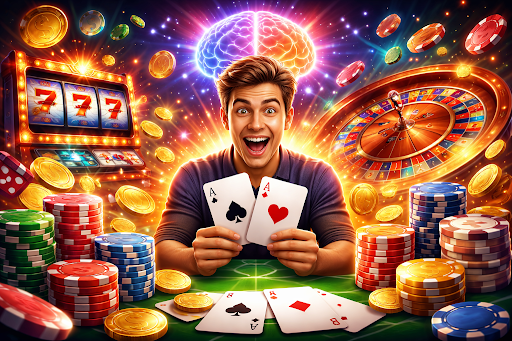
The flashing lights of a casino floor, the rhythmic spinning of a roulette wheel, or the tense silence before a final card is flipped—gambling is an experience defined by its sensory intensity. But beneath the neon surface lies a complex web of neurobiology, behavioral psychology, and cognitive biases.
Understanding why we gamble isn’t just a matter of “wanting to win money.” In fact, for many, the financial outcome is secondary to the psychological journey. In this deep dive, we explore the mechanisms that make the “thrill” so addictive and how players can navigate this landscape with a healthy, informed perspective.
1. The Brain on High Stakes: The Dopamine Loop
At the heart of the gambling experience is dopamine, a neurotransmitter often misunderstood as the “pleasure chemical.” In reality, dopamine is more about anticipation and motivation than the reward itself.
The Uncertainty Principle
Studies show that the brain’s reward system is more active when a reward is uncertain than when it is guaranteed. This is known as variable ratio reinforcement. If you won every time you placed a bet, the “high” would vanish. The fact that you might win—but probably won’t—is exactly what keeps the brain engaged.
The “Near-Miss” Effect
Perhaps the most fascinating psychological quirk is how we process losing. In many games, a “near-miss” (like seeing two out of three matching symbols on a slot machine) is processed by the brain as a “quasi-win.” Instead of discouraging the player, it signals that the win is “just around the corner,” triggering a fresh surge of dopamine.
2. The Illusion of Control
Human beings are wired to seek patterns, even in chaos. This leads to one of the most common psychological traps in gambling: the Illusion of Control.
Many players believe that their personal involvement—how they throw the dice, their “lucky” seat, or their knowledge of past results—can influence a purely random outcome.
- Skill vs. Chance: In games like poker, skill is a genuine factor. However, players often project that same sense of agency onto games of pure chance, like baccarat or slots.
- The Gambler’s Fallacy: This is the belief that if an event happens more frequently than normal during a given period, it will happen less frequently in the future (or vice versa). For example, “Red has hit five times in a row, so Black is due to hit next.” In reality, the odds remain exactly the same for every spin.
3. Escapism and “The Zone”
For some, gambling isn’t about the adrenaline of a big win; it’s about the quietude of the process. Anthropologist Natasha Dow Schüll calls this “The Machine Zone.”
In this state, players enter a trance-like rhythm where the world outside—bills, stress, relationships—fades away. The game becomes a form of digital meditation. This is particularly common in modern slot machine design, where the fast-paced, repetitive nature of the game facilitates a state of total immersion.
4. Practical Guide: How to Maintain a Healthy Relationship with the Thrill
Enjoying the excitement of a wager doesn’t have to lead to negative outcomes. The key is moving from impulsive play to intentional play.
Set a “Thrill Budget”
Treat gambling like any other form of entertainment, such as going to a concert or a theme park.
- The Rule: Only spend money you are 100% prepared to lose.
- The Reality Check: If you find yourself “chasing losses” to get back to even, the psychology of the “near-miss” has taken over. Walk away immediately.
Use the Right Tools and Platforms
Expert players know that the environment matters. Choosing a platform that offers transparency, security, and easy access to your account is vital for a stress-free experience. For instance, players often look for seamless entry points like the 1xbet login bd to manage their activity efficiently. Utilizing a reliable interface allows you to focus on the game itself rather than technical frustrations, which can lead to tilted or emotional decision-making.
Practice “Time-Outs”
The “Machine Zone” thrives on a lack of interruptions. To break the spell:
- Set a timer on your phone for every 30 minutes.
- Stand up and drink water.
- Check in with your emotional state: Are you still having fun, or are you just playing out of habit?
5. The Social Component: Belonging and Competition
We shouldn’t overlook the social psychology of gambling. Whether it’s a weekly poker night or a bustling sportsbook, there is a profound sense of community.
- Social Validation: Winning in front of peers provides a status boost.
- Shared Experience: Even losing can be a bonding moment when “we were all in this together.”
Modern online platforms have recreated this through live dealer games and chat functions, ensuring that even from home, the psychological need for social interaction is met.
6. Cognitive Biases to Watch Out For
To be a smarter player, you must be aware of the “tricks” your mind plays on you:
| Bias | Description | How to Counter It |
| Availability Heuristic | Remembering big wins vividly while forgetting small, frequent losses. | Keep a simple log of all wins and losses to see the real data. |
| Hindsight Bias | The “I knew that was going to happen” feeling after a result. | Acknowledge that you couldn’t have known; it’s just your brain trying to create order. |
| Outcome Bias | Judging a decision based on the result rather than the logic. | Even if a “bad” bet wins, recognize that the decision was still risky and shouldn’t be repeated. |
Conclusion
The psychology of gambling is a fascinating blend of ancient biological drives and modern technological design. We love the thrill because our brains are hardwired to find uncertainty exciting and patterns comforting.
By understanding the “why” behind our impulses—from the dopamine spikes of a near-miss to the comfort of the “zone”—we can enjoy the entertainment value of gambling without falling prey to its cognitive traps. Remember: the house always has an edge, but your greatest edge is a self-aware mind.