
How Can I Make Banana Bread? Easy Recipe With Ripe Bananas
Those overripe bananas sitting on the kitchen counter are perfect for banana bread. Their soft texture makes them easy to mash, while their stronger sweetness gives the loaf its familiar banana flavor. You also do not need special equipment or hard-to-find ingredients.
So, how can i make banana bread that is soft in the middle, nicely browned on top, and fully baked without becoming dry? The key is to use properly ripe bananas, measure the flour carefully, avoid overmixing, and check the center before taking the loaf out of the oven. The recipe below keeps those details simple while giving you enough guidance to avoid the most common problems.
How Can I Make Banana Bread?
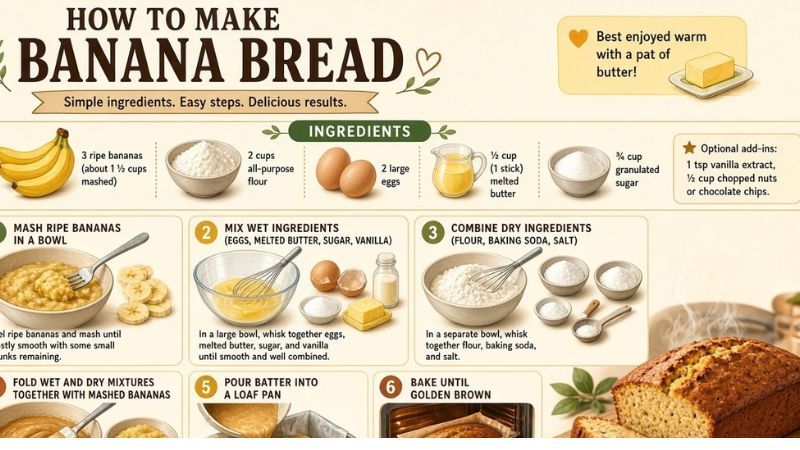
This easy banana bread recipe makes one standard loaf. The batter comes together in one bowl after the dry ingredients are prepared separately, so cleanup is also fairly simple.
Ingredients
- 3 medium ripe bananas, mashed
- 1½ cups (about 180 g) all-purpose flour
- ½ cup (113 g) unsalted butter, melted and slightly cooled
- ½ cup (100 g) granulated sugar
- 2 large eggs
- 1 teaspoon vanilla extract
- 1 teaspoon baking soda
- ½ teaspoon salt
- ½ teaspoon ground cinnamon, optional
- ½ cup chopped walnuts or chocolate chips, optional
Method
- Prepare the oven and pan
Heat the oven to 350°F (175°C). Grease a 9-by-5-inch loaf pan. You can also line it with parchment paper, leaving some paper over the sides to make the baked loaf easier to lift out.
- Mash the bananas
Peel the bananas and mash them with a fork in a large bowl. They do not need to be perfectly smooth. A few small pieces of banana are fine.
For the most flavorful banana bread, use bananas that are very ripe and soft, with plenty of brown spots on the peel.
- Add the wet ingredients
Stir the melted butter, sugar, eggs, and vanilla into the mashed bananas.
The butter should be melted but not hot. Very hot butter can make the mixture less pleasant to work with and may affect the eggs.
- Combine the dry ingredients
In a separate bowl, whisk together the flour, baking soda, salt, and cinnamon.
Measure the flour carefully. For the most consistent result, spoon flour into a measuring cup and level it rather than packing it down.
- Make the batter
Add the dry ingredients to the banana mixture. Stir gently with a spatula or wooden spoon until the flour has just disappeared.
Do not keep mixing until the batter looks completely smooth. A few small lumps are perfectly fine.
- Add your extras
Fold in walnuts, pecans, or chocolate chips if you want them. About ½ cup is enough to add texture without making the loaf difficult to slice.
- Bake
Pour the batter into the prepared loaf pan and smooth the top.
Bake for approximately 50 to 60 minutes, checking toward the end of the baking time. The exact time can vary with your oven, pan, and the size of the bananas.
- Check the center
Insert a toothpick or wooden skewer into the center of the loaf. It should come out clean or with a few moist crumbs attached.
Wet batter on the toothpick means the loaf needs more time.
- Cool before slicing
Leave the banana bread in the pan for about 10 to 15 minutes after taking it out of the oven. Then transfer it to a wire rack. Let it cool further before slicing. Cutting into a very hot loaf can make the center seem wetter and cause the slices to fall apart.
Choosing the Right Bananas
The bananas make up a large part of the flavor and moisture in banana bread, so their condition matters. Look for bananas that are soft, heavily speckled, and naturally sweet. Brown or very dark peels are not a problem by themselves. Peel the banana and check the fruit inside; mold or an unpleasant spoiled smell means it should not be used.
Yellow bananas can also be baked into banana bread, but they usually produce a milder banana flavor. Very ripe bananas are easier to mash and generally give the loaf more sweetness.
One detail that is easy to overlook is banana size. Saying “three bananas” does not mean every baker is adding the same amount of fruit. Very large bananas can add considerably more moisture than small ones. For repeatable results, measure the mashed banana when a recipe gives a weight or volume.
Getting a Soft and Moist Loaf
A moist banana bread should feel soft when you press the top lightly, but it should not have a wet or paste-like center. Three things make the biggest difference:
Measure the flour correctly. Extra flour is one of the easiest ways to end up with a dry loaf.
Do not overmix. Once the flour has been incorporated, stop stirring. Excessive mixing can make the crumb heavier.
Bake until the center is done. Taking the loaf out too early may leave a gummy middle, while leaving it in the oven long after it is cooked can dry it out.
The amount of banana matters too. Adding an extra banana to a recipe simply because you have one available can change the moisture balance. More banana does not automatically produce better banana bread.
Baking Time and Signs of Doneness
A standard 9-by-5-inch loaf usually needs around 50 to 60 minutes at 350°F (175°C), but treat that as a guide rather than a fixed rule. A smaller or deeper pan can change the baking time. So can an oven that runs hotter or cooler than its displayed setting.
Look for three signs when checking the loaf:
- The top should be well browned and set.
- The center should no longer look wet or sunken.
- A toothpick inserted into the middle should come out clean or with a few moist crumbs.
If you have an instant-read thermometer, the center of a fully baked quick bread is often around 200–205°F (93–96°C).
The toothpick test is still the easiest method for most home bakers.
Fixing Common Banana Bread Problems
Even a simple banana bread recipe can go wrong. Most problems have a fairly straightforward cause.
| Problem | Likely reason | What to do |
| Gummy middle | Too much moisture or not enough baking time | Measure banana accurately and bake until the center is set |
| Dry loaf | Too much flour or overbaking | Measure flour carefully and start checking earlier |
| Dense texture | Overmixing or incorrect ingredient ratios | Mix only until the flour disappears |
| Burnt top with raw center | Oven too hot or loaf too deep | Cover the top loosely with foil and continue baking |
| Sunken middle | Center not fully baked | Check the middle before removing the loaf |
| Pale, heavy loaf | Oven temperature may be low | Check your oven temperature and allow enough baking time |
A particularly common mistake is judging the loaf only by its crust. Banana bread can develop a beautiful brown top while the middle still contains uncooked batter.
When that happens, do not increase the oven temperature sharply. Cover the top loosely with foil and give the center more time to cook.
Easy Ways to Change the Recipe
Once you have the basic banana bread recipe working, there are several simple ways to change it.
Chocolate Chip Banana Bread
Fold about ½ cup of chocolate chips into the batter. Dark or semisweet chocolate works particularly well because it balances the sweetness of ripe bananas.
Walnut Banana Bread
Chopped walnuts add crunch and a slightly earthy flavor. Toasting them lightly before adding them can make their flavor more noticeable.
Cinnamon Banana Bread
Add cinnamon to the dry ingredients for a warmer flavor. A small amount of nutmeg can also work well.
Banana Bread With Frozen Bananas
Very ripe bananas can be peeled, sealed, and frozen for later.
Thaw them before using. Frozen bananas become extremely soft after thawing and may release some liquid. That is normal, but measure the banana after thawing and avoid adding substantially more fruit than the recipe calls for.
Banana Bread With Whole-Wheat Flour
Whole-wheat flour can replace part of the all-purpose flour, giving the loaf a more pronounced grain flavor.
For a softer texture, start by replacing only part of the all-purpose flour rather than changing the entire amount at once. A recipe specifically developed for whole-wheat banana bread is a better choice when you want to use only whole-wheat flour.
Common Mistakes to Avoid
Banana bread does not require complicated baking skills, but a few small mistakes can change the result.
- Using too little banana: Very small bananas may not provide the amount of moisture the recipe expects.
- Adding too much banana: Extra fruit can leave the center overly wet.
- Packing flour into the measuring cup: This can add more flour than intended and make the loaf heavy.
- Overmixing the batter: Stir only until the dry ingredients are incorporated.
- Using the wrong pan size: A smaller pan can make the batter deeper and increase the baking time.
- Removing the loaf too early: A browned crust does not guarantee that the middle is cooked.
- Slicing immediately: Freshly baked banana bread needs time to settle and firm up.
These are simple things, but fixing them can make the difference between a loaf that is merely edible and one you will want to bake again.
Storing and Freezing Banana Bread
Allow the loaf to cool completely before storing it. For short-term storage, wrap the banana bread tightly or place it in an airtight container. It can generally be kept at room temperature for several days while retaining good quality.
For longer storage, freezing works well. You can freeze the entire loaf or cut it into individual slices. Slices are more convenient because you can thaw only what you plan to eat.
Place parchment between slices before freezing so they do not stick together. Store the wrapped bread in a freezer-safe bag or container. To serve, thaw a slice at room temperature or warm it gently.
Frequently Asked Questions (FAQs)
Q1. Can I use frozen bananas for banana bread?
Yes. Thaw them first and measure the bananas after thawing. They will become very soft and may release some liquid, which is normal.
Q2. Can I use two bananas instead of three?
You can, but the recipe’s texture and sweetness will change. It is better to use a recipe designed for two bananas than to simply remove one from a three-banana recipe.
Q3. How do I know when banana bread is fully baked?
Insert a toothpick or skewer into the center. It should come out clean or with a few moist crumbs. Wet batter means it needs more time.
Q4. Why does my banana bread sink in the middle?
The center may not have been fully baked before the loaf was removed from the oven. Excess moisture or opening the oven too early can also contribute to a sunken center.
Q5. How can i make banana bread without overbaking it?
Follow the recommended temperature and start checking the loaf toward the end of the suggested baking time. Insert a toothpick into the center and remove the bread when it comes out clean or with a few moist crumbs. Let it cool before slicing so the crumb can finish setting.
Wrapping Up
Good banana bread is less about complicated baking techniques and more about getting a few basic details right. Use soft, ripe bananas, measure the flour carefully, mix the batter just until combined, and make sure the center is fully baked before removing the loaf.
Once you know how can i make banana bread successfully, you can adapt the basic recipe with chocolate chips, walnuts, cinnamon, or whole-wheat flour without losing the qualities that make a good loaf soft and flavorful. For the best results, pay attention to the batter and the finished loaf rather than relying on baking time alone.